Planning
How do podcasts make money?
By the team at The Cast Studio · Updated · 10 min read
In short
Podcasts make money in seven ways: sponsorships (Libsyn Ads lists $24 to $26 per 1,000 downloads for a 60-second host-read ad), Spotify and YouTube programs, subscriptions, affiliate links, your own services, live events and clips. Most shows earn little from ads at first. For a business, the payoff is usually clients and deals, not ad income.
Most podcasts earn little from ads at the start, so it pays to know every way a show can make money before you pick one. This guide covers all seven, with the real thresholds, rates and fees that Spotify, YouTube, Apple, Patreon and Libsyn Ads publish, checked on October 4, 2026. It also explains what a business podcast earns, which is usually clients and deals instead of ad income.
How do podcasts make money?
Podcasts make money in seven main ways: sponsorships, platform programs, listener subscriptions, affiliate links, your own products and services, live events and paid appearances, and clips that grow the audience for the other six.
| Method | Typical requirement | How you are paid | Fits which shows |
|---|---|---|---|
| Sponsorships and host-read ads | An audience you can count in downloads | A rate per 1,000 downloads (CPM) | Shows with steady downloads |
| Platform programs | Audience thresholds set by Spotify and YouTube | Paid by the platform once you qualify | Shows already growing on those platforms |
| Listener subscriptions | Listeners who will pay for extra | A share of each subscription | Shows with a loyal audience |
| Affiliate links | An audience that trusts your picks | A commission on sales through your link | Shows that recommend products or tools |
| Your own products and services | Something to sell: a course, coaching, consulting or a book | Directly from your customers | Business, coaching and expert shows |
| Live events and paid appearances | A topic or name people turn up for | Per event or appearance | Shows with a recognizable host or community |
| Clips and brand content | Short videos cut from each episode | Indirectly, through a bigger audience | Every show |
You do not need all seven. To monetize a podcast, pick the one or two that fit your show and your audience today, and add others as the audience grows. The sections below give the details for each, with real numbers where a source has them.
How much do sponsors pay podcasts?
Sponsors pay by the thousand downloads, a price called CPM, and for a 60-second host-read ad the Libsyn Ads 2026 guide lists $24 to $26 per 1,000 downloads. The price of one ad follows a simple formula: ad price = reach × CPM / 1,000, where reach is the downloads an episode gets in its first 30 days.
As an illustration, an episode with 5,000 downloads in its first 30 days, sold at a $25 CPM, brings in 5,000 × $25 / 1,000 = $125 for one 60-second host-read ad. That is arithmetic, not an average or a promise.
Libsyn Ads lists a rate for each ad type:
| Ad type | CPM (price per 1,000 downloads) |
|---|---|
| Host-read, 60 seconds | $24 to $26 |
| Host-read, 30 seconds | $18 to $22 |
| Dynamic episodic | $18 to $22 |
| Back catalog | $14 to $16 |
| Programmatic | $12 to $15 |
These rates apply to pre-roll and mid-roll ads. The 60-second host-read spot has the highest rate on the list and programmatic ads the lowest. The ad types are Libsyn Ads' own labels, so ask any seller what each one includes before you compare offers.
Our guide to podcast sponsorship covers how to get sponsors and what to charge.
Advertisers are spending more on podcasts. US podcast advertising revenue was $2.9 billion in 2025 ($2,862.2 million), up 17.6% from $2,433.1 million in 2024, according to the IAB/PwC Internet Advertising Revenue Report. That does not show what a small show will earn, which depends on its own downloads.
Say it out loud
If you read a sponsor's message in an episode, say that it is sponsored. The FTC's endorsement guidance says that when an endorsement is spoken, the disclosure should be spoken at the very least. Open the ad with "this episode is sponsored by" or "this episode is brought to you by". This is not legal advice, so check the FTC's guidance for your situation.
Can you get paid by Spotify or YouTube for a podcast?
Yes, once your show meets the thresholds that Spotify and YouTube set for their partner programs. As of October 4, 2026:
- Spotify Partner Program. You need at least 3 published episodes, plus 2,000 consumption hours and 1,000 unique listeners or viewers in the last 30 days. The show must be hosted on Spotify for Creators, in an eligible country (the US is one). To stay eligible, publish an episode and earn at least $10 in any 6-month period.
- YouTube Partner Program. You need 1,000 subscribers plus either 4,000 public watch hours in the last 12 months or 10 million Shorts views in the last 90 days.
The two programs measure different windows: Spotify looks at the last 30 days, YouTube at 12 months of watch hours or 90 days of Shorts views. Thresholds also change. Spotify lowered its bar in January 2026, from 12 episodes, 10,000 hours and 2,000 listeners to the numbers above, so check each platform's own page before you plan around a number.
If YouTube is your main channel, our step-by-step guide to starting a YouTube podcast covers setup, editing, thumbnails, titles, chapters and clips.
Can listeners pay for your podcast directly?
Yes, through listener subscriptions, and both Apple and Patreon publish their terms.
- Apple Podcasters Program. The program fee is $19.99 per year. Creators receive 70% of the subscription price in a subscriber's first year and 85% after one year of paid service.
- Patreon. The platform fee is 10% of your income, plus payment processing, currency conversion and payout fees.
For example, of each $10 of subscription price on Apple, you receive $7 in a subscriber's first year and $8.50 after one year of paid service. On Patreon, $1 of each $10 of income goes to the platform fee, before the other fees.
Subscriptions work when paying listeners get something the free feed does not. Decide what that is, and how much of your time it takes, before you set a price.
Do affiliate links make money for podcasts?
Yes: an affiliate link pays you a commission on sales made through it, and the rate depends on the program, so we quote none. Read each program's terms before you promote anything, and recommend only what you use. Mention the link in the episode, put it in the show notes and tell listeners you are paid when they buy through it. Check the FTC's guidance on disclosures before you start.
Can you sell your own products and services through a podcast?
Yes, and this is often where business podcasts earn most: courses, coaching, consulting and books. There is no program to qualify for, so a show can start selling from its first episode.
An episode works as a long, free sample of how you think, and the listeners who like it are the ones most likely to hire you or buy from you. End each episode with one clear next step, such as a consultation, a course page or a book. If you coach, teach or advise for a living, see our video studio for coaches and experts.
Can a podcast lead to live events and paid appearances?
Yes: a podcast can lead to paid speaking, live shows and workshops. No standard rate applies, because fees depend on the event and on you. What the show does is let organizers hear how you speak and what you know before they book you, so record it well and keep your strongest episodes easy to find.
Do podcast clips make money?
Not directly: clips grow the audience that every other method on this list depends on. A short video cut from each episode gives people a reason to find the full show, and our guide to podcast clips has a four-week plan built from one episode.
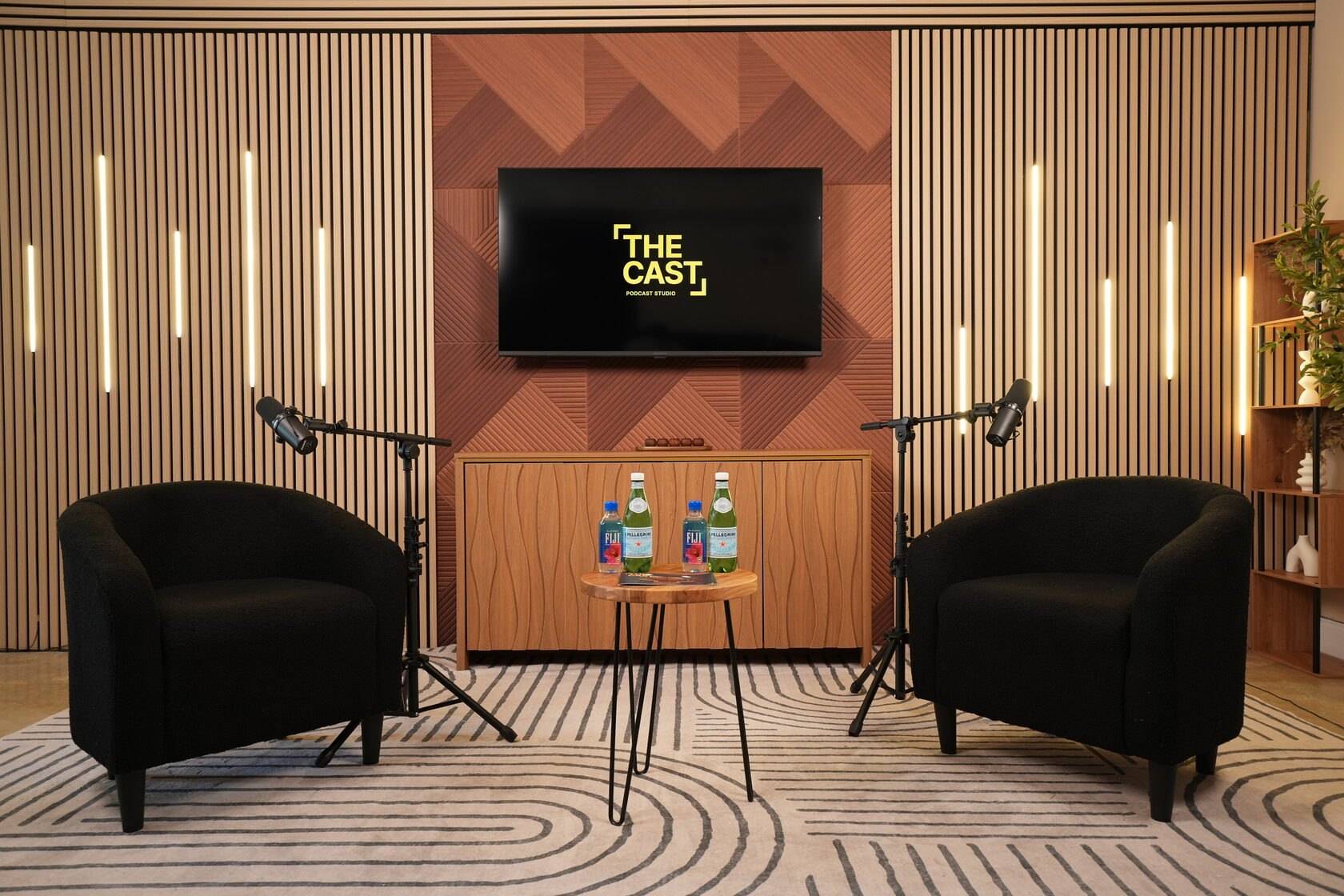
If you record in a studio, the footage is your raw material. At The Cast Studio, the Studio Recording packages record three 4K angles and include thumbnail and guest photos plus behind-the-scenes photos and video. You can see the packages and prices on our podcast studio rental page.
How much do podcasters make?
It depends on downloads, the rate per 1,000 and the number of ads you sell, and you can estimate all three yourself. We do not quote an average income, because we have no sourced figure for one. Use the sponsorship formula with your own numbers instead. At a $25 CPM, the midpoint of the $24 to $26 range, one 60-second host-read ad is worth:
| Downloads in the first 30 days | One 60-second host-read ad at a $25 CPM |
|---|---|
| 1,000 | $25 |
| 5,000 | $125 |
| 20,000 | $500 |
These figures illustrate the formula. They are not averages or promises. Sell two such ads per episode and they double. Publish four episodes a month, each with 5,000 downloads and one ad, and the month comes to 4 × $125 = $500.
You can also work backwards from a goal. To earn $1,000 a month at a $25 CPM from one 60-second host-read ad on each of four episodes, every episode needs 10,000 downloads in its first 30 days: 10,000 × $25 / 1,000 = $250 per episode, and 4 × $250 = $1,000.
Then subtract what the show costs: podcast hosting, editing software, gear or studio time, and your own hours. Our guide to how much it costs to start a podcast builds that budget, from gear to hosting and editing software. Ad income grows with your audience, so it is small at the start. A service you already sell does not wait for the audience to grow.
When should you start monetizing?
Start once you publish on a steady schedule and can measure your audience, with one exception: a business show can sell its own services from the first episode. A sensible order:
- Publish on a schedule you can keep. The numbers buyers use are recent ones: downloads in an episode's first 30 days, listeners and hours over the last 30 days, watch hours over the last 12 months.
- Track what each buyer counts. Sponsors count downloads. Spotify counts unique listeners or viewers and consumption hours. YouTube counts subscribers and watch hours.
- Grow the audience. Every method on this list gets easier as it grows, and our guide on how to promote a podcast covers 15 ways to do it.
- Add one method at a time. Start with the one that fits where your show is now.
Use this table to choose the first one:
| If you have... | Start with... |
|---|---|
| A service, course or book to sell | Your own products and services, from episode one |
| Steady downloads in a clear niche | Sponsorships, priced by CPM |
| An audience near the Spotify or YouTube thresholds | The platform program |
| Listeners who ask for more | A paid subscription |
| An audience that trusts your recommendations | Affiliate links |
| A small audience so far | Steady episodes and clips to grow it |
What does a business podcast earn?
A business podcast usually earns through what it leads to, such as clients, deals and authority, not through ad income. The show works like a long conversation with people who may hire you, buy from you or partner with you:
- Clients. A prospect who has heard you explain a problem arrives at the first call already knowing how you think.
- Deals. A guest can become a partner, a referrer or a client, and an invitation to record is an easy first step toward working together.
- Authority. Months of episodes on one subject make you a familiar voice in your field.
Judge it by those results. Count the clients who mention an episode, the guests who became partners and the invitations to speak, and ask every new client how they heard about you, with the show as one of the answers. Then do the arithmetic with your own number: what is one new client worth to you, and how many does the show need to bring in to justify the time and money?
Our guide to a podcast for business covers goals, formats and how to measure beyond downloads, and if you sell homes, our guide to a real estate podcast covers formats and guests. If you run a company and want to record in a studio, see our page for business owners.
Planning a show that should bring in clients? Talk it through on a free studio tour, or book a session.
Sources and method
Every outside number in this article comes from the sources below, all checked on October 4, 2026.
- Libsyn Ads, "Podcast Advertising 2026 Ultimate Guide" (advertising.libsyn.com): the pricing formula and the rate for each ad type.
- Spotify Support, "Spotify Partner Program" (support.spotify.com/us/creators/article/spotify-partner-program/), and Spotify Newsroom, January 7, 2026: the current thresholds and the January 2026 change.
- YouTube Help, YouTube Partner Program overview (support.google.com/youtube/answer/72851): the thresholds.
- Apple Podcasts for Creators, Apple Podcasts Subscriptions (podcasters.apple.com): the program fee and the revenue share.
- Patreon pricing (patreon.com/pricing): the platform fee.
- FTC, "FTC's Endorsement Guides: What People Are Asking": the disclosure guidance.
- IAB/PwC Internet Advertising Revenue Report, full-year 2025, published April 2026, page 24: US podcast advertising revenue.
Platform thresholds, rates and fees change without notice, so confirm them on the source before you plan around them. The examples use $25, the midpoint of Libsyn Ads' $24 to $26 range for a 60-second host-read ad, and are arithmetic, not averages or results from any show. We found no reliable source for an average podcaster's income, so we quote none. Details about The Cast Studio come from its published packages and sets.
Frequently asked questions
How much do podcasts make per 1,000 downloads?
For a 60-second host-read ad, the Libsyn Ads 2026 guide lists $24 to $26 per 1,000 downloads. At $25 per 1,000, for example, 5,000 downloads in 30 days bring in $125 for one ad. A 30-second host-read ad is $18 to $22, and programmatic ads are $12 to $15. These rates apply to pre-roll or mid-roll placements.
How many listeners do you need to make money from a podcast?
There is no single number, because each method counts your audience differently. Sponsors count downloads. Spotify's program asks for 1,000 unique listeners or viewers and 2,000 consumption hours in the last 30 days, and YouTube asks for 1,000 subscribers plus 4,000 public watch hours in 12 months (or 10 million Shorts views in 90 days). Selling your own services needs no minimum.
Does Spotify pay podcasters?
It can, through the Spotify Partner Program. You need at least 3 published episodes, plus 2,000 consumption hours and 1,000 unique listeners or viewers in the last 30 days, with the show hosted on Spotify for Creators in an eligible country, which includes the US. To stay eligible, publish an episode and earn at least $10 in any 6-month period.
Do podcasts make money on YouTube?
They can, through the YouTube Partner Program, which asks for 1,000 subscribers plus either 4,000 public watch hours in the last 12 months or 10 million Shorts views in the last 90 days. Until you get there, sponsors, affiliate links and your own services do not depend on the program.
What is the fastest way for a business podcast to pay for itself?
Usually by selling what you already sell. A business show can earn through its own services from the first episode, so invite prospects and partners as guests, send episodes to people before a sales call and note which new clients mention the show. Ad income is small at the start, while clients and deals are the usual payoff.
How do you disclose a podcast sponsor?
Say it out loud in the episode, for example 'this episode is sponsored by' or 'this episode is brought to you by'. The FTC's endorsement guidance says that when an endorsement is spoken, the disclosure should be spoken at the very least. This is not legal advice, so check the FTC's guidance for your situation.
Written by the team at The Cast Studio, a podcast and video studio at 801 NE 2nd Ave, Ste 120, Fort Lauderdale, FL 33304. Facts and prices are checked on the date shown above. About the studio.